
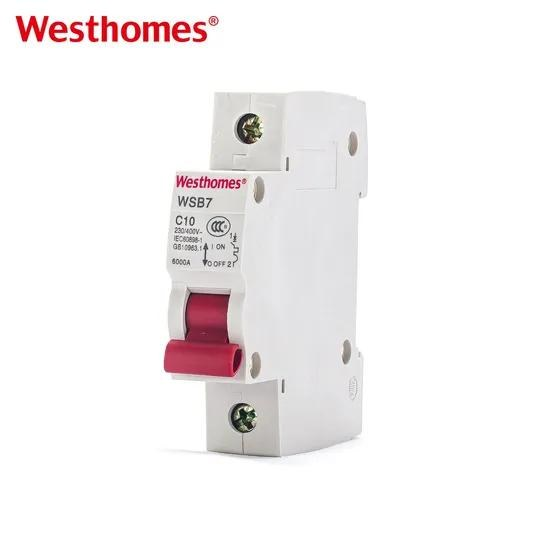
When selecting a DIN rail miniature circuit breaker (MCB), rated current is only one part of the specification. Breaking capacity, tripping characteristics, pole configuration and installation dimensions also need to be considered to ensure compatibility with the electrical system.
These details are particularly important when comparing breakers for residential, commercial and industrial distribution boards, where similar-looking devices may have different electrical ratings.
Understanding Short-Circuit Breaking Capacity
Breaking capacity indicates the prospective short-circuit current a circuit breaker is designed to interrupt under specified conditions. It is expressed in kiloamperes (kA) and should be selected according to the available fault current at the installation point.
The WSB7-63 miniature circuit breaker from Westhomes Electric is available in 1P, 2P, 3P and 4P configurations, with rated currents ranging from 6A to 63A and voltage ratings of AC 230V/400V.
According to the published technical data, the WSB7 series has a short-circuit breaking capacity of 6,000A for current ratings from 6A to 40A and 4,500A for 50A and 63A versions.
These differences should be checked when specifying breakers for a distribution board. A breaking capacity listed for one current rating should not automatically be assumed to apply to every model in the same series.
Selecting the Appropriate Trip Curve
MCBs are available with different instantaneous tripping characteristics to accommodate various load conditions.
Type B breakers typically operate within an instantaneous tripping range of 3–5 times the rated current. They are commonly used in circuits with relatively low inrush currents.
Type C breakers have an instantaneous tripping range of 5–10 times the rated current and are often selected for mixed electrical loads and equipment with moderate starting currents.
Type D breakers operate at approximately 10–20 times the rated current, making them suitable for certain applications involving higher inrush currents.
The appropriate trip curve depends on the connected load, expected starting current and required protection characteristics. Selection should also account for conductor protection, fault-loop conditions and coordination with other protective devices.
Pole Configuration and Installation Dimensions
The number of poles affects both the electrical configuration and the space occupied inside the distribution board.
The WSB7-63 series uses standard modular widths of 18mm for 1P, 36mm for 2P, 54mm for 3P and 72mm for 4P configurations.
These dimensions are useful when planning DIN rail space, particularly in panels containing several outgoing circuits and protective devices.
Westhomes also offers the WSB9-80 series, with rated currents extending to 80A and available 6kA and 10kA breaking-capacity variants. The published product range uses corresponding modular widths from 18mm to 72mm.
Before ordering, panel builders should confirm the exact model dimensions, rated current and applicable breaking-capacity rating against the manufacturer’s technical documentation.
Understanding 1P+N Configurations
A 1P+N arrangement is commonly used in single-phase electrical installations where the phase and neutral conductors require a defined switching arrangement.
The Westhomes WSB7LE-63 range includes a 1P+N configuration with a width of 36mm and a rated voltage of AC 230V. Its published breaking-capacity ratings are 6kA for 6–40A versions and 4.5kA for 50–63A versions.
The WSB7LE series is a residual current circuit breaker with overcurrent protection (RCBO), providing residual current protection in addition to overload and short-circuit protection.
When specifying a 1P+N device, the product type, neutral-pole arrangement and applicable protection functions should be verified. Devices with similar pole markings do not necessarily provide identical protection or isolation characteristics.
Checking Electrical Ratings and Test Conditions
Technical specifications should be reviewed together with the conditions under which the ratings are established.
For the WSB7 series, the published technical data includes a power factor of 0.7 alongside its short-circuit performance information.
Breaking-capacity requirements should be evaluated with reference to the applicable product standard, rated voltage and short-circuit test conditions.
For procurement projects, the relevant certificates and technical data sheets should be checked to confirm that the selected breaker meets the installation requirements.
Product Range and Manufacturing Background
Westhomes Electric manufactures low-voltage electrical protection and control products, including miniature circuit breakers, molded case circuit breakers, automatic transfer switches, surge protection devices and motor control equipment.
Founded in 1998, the company supplies electrical products to international markets and supports applications in residential, commercial and industrial electrical distribution.
Its product range also includes automatic overvoltage and undervoltage protective devices, allowing buyers to source different types of protection equipment for distribution board applications.
For panel manufacturers and electrical contractors, product documentation, model consistency and compatibility with existing equipment are important considerations when evaluating suppliers.
Key Information to Confirm Before Ordering
A complete MCB specification should include the rated current, rated voltage, breaking capacity, trip curve, number of poles and installation dimensions.
Additional details may be required depending on the application, including operating frequency, applicable standards, terminal arrangements and coordination requirements.
Reviewing these specifications before placing an order helps ensure that the selected breaker is suitable for the intended circuit and can be installed within the available panel space.
Conclusion
DIN rail miniature circuit breakers should be selected according to the electrical characteristics of the installation rather than rated current alone.
Breaking capacity, trip curve and pole configuration are particularly important when comparing models. Checking these details against the manufacturer’s technical documentation provides a more reliable basis for equipment selection and procurement.